The Miracles of Pentecost
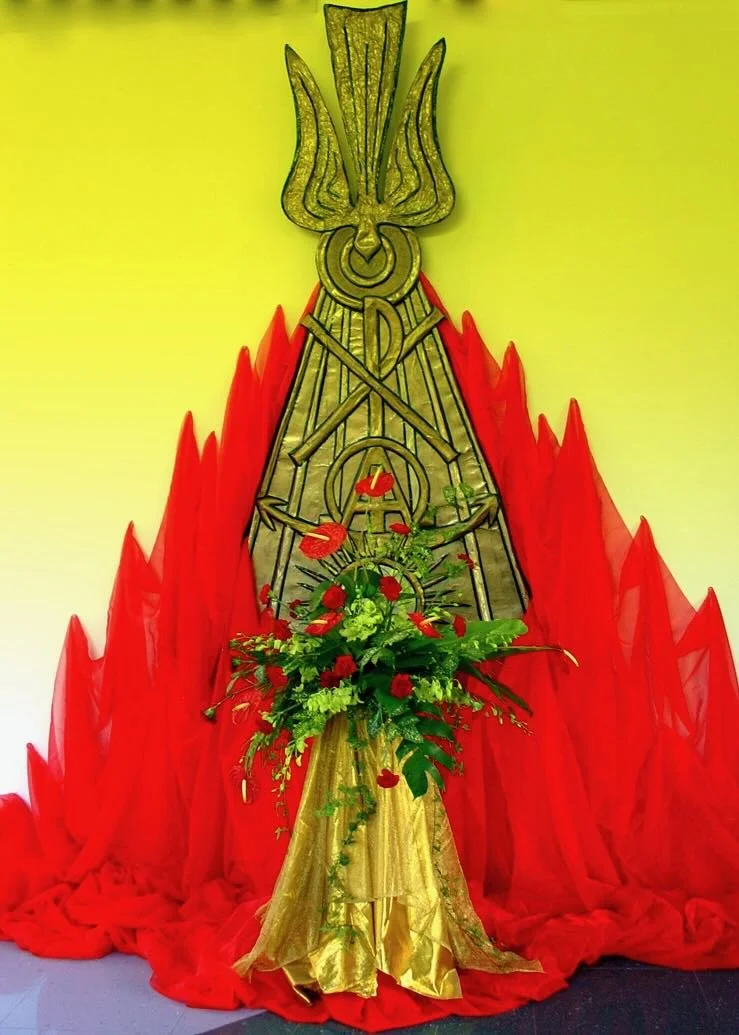
Church of the Holy Spirit, Singapore. Happy Pentecost!, from Art in the Christian Tradition, a project of the Vanderbilt Divinity Library, Nashville, TN. https://diglib.library.vanderbilt.edu/act-imagelink.pl?RC=54350[retrieved May 22, 2026]. Original source: http://www.flickr.com/photos/eustaquio/3580213825/.
Genesis 11:1-9; Acts of the Apostles 2:1-11
At Pentecost, I naturally remember a few dramatic re-enactments of this scripture reading. In Wichita, for example, the senior pastor recruited several people who were fluent in various foreign languages to read in unison. Hearing that gave us all a taste of the excitement and confusion that must have been felt on the first Pentecost.
The text reminds me of the challenges of communicating across languages and cultures. To this point, writer David Sedaris describes a French class he enrolled in shortly after moving to Paris. The class was learning about holiday traditions. A student from Morocco piped up, “Excuse me, but what’s an ‘Easter’?” The other students, within the limits of their infant French, struggled to explain.
Here are some of their answers, translated from French. “It is a party of the little boy of God who call his self Jesus.” “He die one day and then he go above of my head to live with your father.” “He weared of himself the long hair, and after he die, the first day he come back here for to say hello to the peoples.” “He nice, the Jesus.” “He make the good things, and on Easter we be sad because somebody make him dead today.”[1]
To talk about Jesus’ resurrection is challenging even when we all speak the same language. When we don’t, the task may seem nearly impossible. As we read the story told in the second chapter of Acts, what happened is truly a miracle. The miracle is not merely speaking in a new language. As impressive as that is, it would mean nothing without the associated miracle of hearing the message and belonging to a new community. In other words, the Holy Spirit is more than a glorified foreign-language teacher. The Spirit brought understanding across barriers that should have divided people, and created a community of love and grace.
In context, Luke has shared Jesus’ post-resurrection appearances, and Jesus’ instruction that the disciples share the good news with the world, but to wait for a special gift before starting. Then, on the Day of Pentecost, the Holy Spirit that Jesus promised empowered the disciples to practice evangelism across barriers of language and culture.
Evangelism: When you hear the word, you may think of certain infamous television preachers. You may be reminded of someone who interrupted your Saturday afternoon with a knock on the front door, and a desire to engage you in a conversation about the state of your soul. When Therese and I think of evangelism, we recall our student days in Campus Crusade for Christ, during which we were trained to talk about our faith to fellow college students.
Jeff Friend and Chris Huber are former Campus Crusaders who used to publish a comic strip for Christian magazines. One of their strips lampoons the excesses of aggressive evangelism. A mentor figure named “Doug” is disappointed with the technique of his young protégé “Bobo.” He advises Bobo to add an emotional hook or attention-getting device to make his conversations more effective. In the final panel, the exaggeration in Bobo’s story exceeds Doug’s expectations. Bobo says to a potential convert, “By (age) four, my life was out of control. I had turned my Cub Scout pack into a den of Satanism and debauchery. Our fleshly lifestyle was financed by distributing crack cocaine to the inner city for the CIA. During gangland warfare at recess, Jesus, along with Elijah and Michael the Archangel, approached with a gospel tract. It was only then that I changed my ways. Now, having figured out life and the answer to all ethical dilemmas, I am in a permanent state of joy. This never would have happened if I wasn’t shamed into turning to Christ.” In the background, beaming mentor Doug comments, “I’m so proud.”
If that’s evangelism, Presbyterians want nothing to do with it.
And perhaps that is why the word makes many of us uneasy. We fear manipulation, pressure, or spiritual salesmanship. But that is not what Pentecost looks like. At Pentecost, nobody is manipulated; they are astonished and attracted.
Perhaps it’s a little bit like a story I’ve kept in my files from my first trip to London, when I picked up a copy of the Sunday Times. A feature story commemorated the 40th anniversary of one of the most successful bands in the history of rock and roll. It started on a snowy night in February, 1963, when the band opened for the first time at the Crawdaddy Club in west London. Three people were in the audience – less than the number of band members on stage. Band members wondered whether they should bother to play.
The band’s promoter asked, “How many people you think could fit in here?” They replied that they thought about one hundred people. He said, “Okay, play as if there were 100 here, and they’ll come.”
At the end of the evening, the three members of the audience were saying, “This is great. This is our music.” The promoter promised the three members of the audience that if each came back with two friends, they all would be admitted free. Each weekend, the attendance grew. Soon the place became so popular that people had to stand in line to get in. A new hit band had been born: “The Rolling Stones.”[2]
Evangelism is something like that. Christians share good news for the same reason anyone shares what they love—but for us the good news is grounded in what God has done through Jesus Christ.
Has your life been changed by a relationship with God through Jesus Christ? In your association with First Presbyterian Church, have you been enriched by a relationship? Have you experienced personal growth through a program? Have you been shaped by a service opportunity? If the answer is “yes,” then you have “good news” to share.
Do you have co-workers with whom you feel comfortable talking at break about what you did during the weekend? Do you have neighbors with whom you feel comfortable discussing over the fence news of the community? Do you know people who enjoy fine music? If the answer is “yes,” then you have the opportunity to be an evangelist, to share the good news of what God has done for you.
I invite you to take a moment and look around the room. Do you see someone whom you invited or brought to this place? Do you see someone whom you encouraged or nurtured to explore affiliation with this congregation? If so, then you are already an evangelist. As I look around the room, in my mind’s eye I see tongues of fire and remember Spirit-inspired speech.
The miracle of Pentecost didn’t end in Jerusalem. Whenever fear gives way to courage, whenever strangers become neighbors, whenever the love of Christ is spoken in words another person can truly hear, the Holy Spirit is still at work. Thanks be to God, who has empowered the Church through every generation and empowers us still to be messengers of grace and peace.
In the name of the Father, and of the Son, and of the Holy Spirit. AMEN.
NOTES
[1] David Sedaris, as quoted by Heidi Neumark, “Translating Easter,” Christian Century 20 April 2004, p. 8.
[2] “Their Majesties: Drugs, girls, arrests, rows and death – the Rolling Stones, after 40 years and many unofficial histories, are at last revealing their tumultuous story in their own words in a remarkable joint autobiography,” The Sunday Times of London 10 August 2003, sec. 4, p. 1, col. 1.
READ MORE, https://www.fpcedw.org/pastors-blog