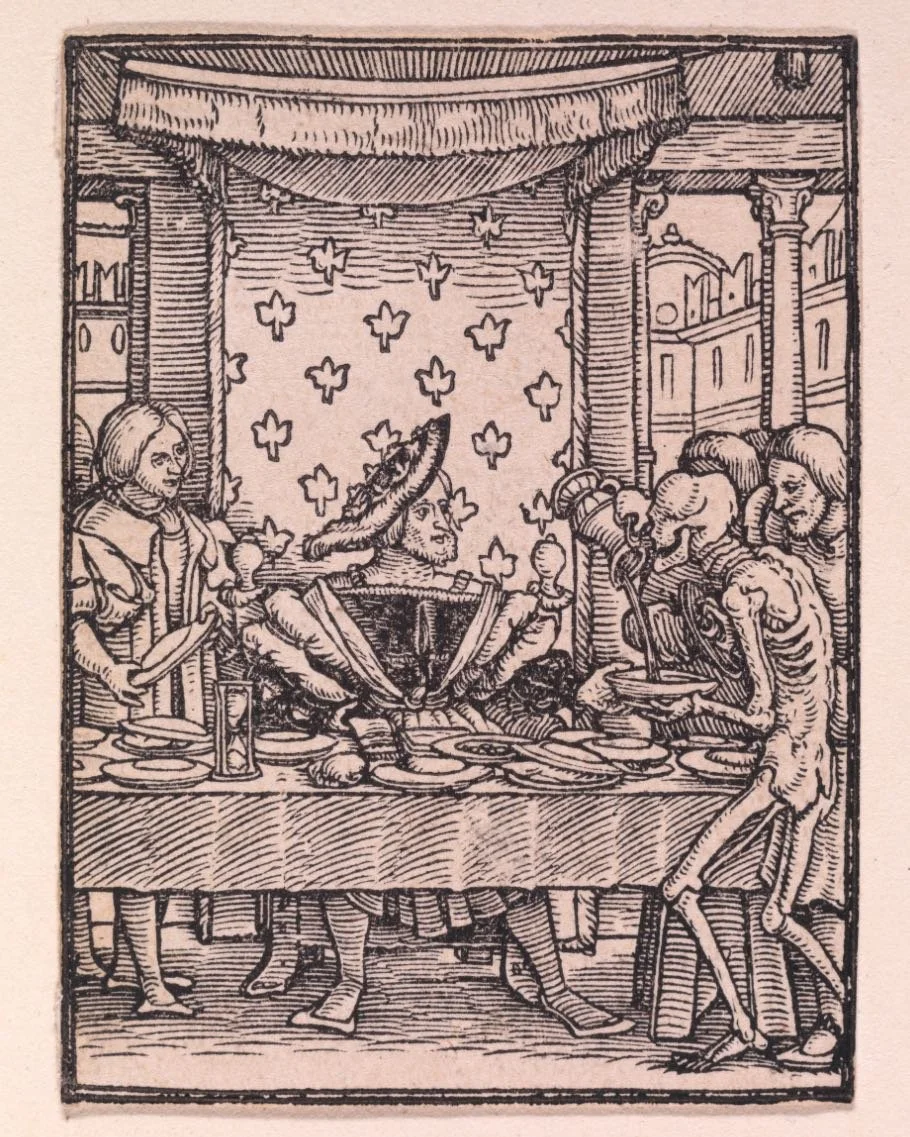
The Rich Man, from "The Dance of Death,” Hans Holbein the Younger (German), Printmaker Hans Lützelburger (German), ca. 1526, published 1538, in the Met Collection, public domain, click on the image to link.
1 Timothy 6:6-10; Luke 12:15-21
“Take care!” Jesus warned. “Be on your guard against all kinds of greed; for one’s life does not consist in the abundance of possessions.” If that was true in the first century, how much more in ours.
This past Sunday, I read an essay by Evan Gorelick, a writer for the New York Times.[1] He was commenting on the rise of online prediction markets like Polymarket and Kalshi. Gambling no longer has familiar boundaries. Now you can bet on virtually anything: What word a politician will use on a given day, or what item of clothing a celebrity will wear. The writer of the article discovered that someone had bet money on how many users would view one of his tweets.
According to one tracking organization, worldwide gambling revenue – from lotteries, bingo, casinos, gaming, and sports betting – is growing and exceeds $600 billion per year.[2]Gambling has become “gamified,” making it easier to get addicted, and the number of people seeking help for gambling addictions is growing. Lia Nower, director of the Center for Gambling Studies at Rutgers, says, “From the time you’re 5 years old, you’re being primed to gamble.”[3]
When I say I grieve the rise in gambling, I want to be careful to avoid misunderstanding. I’m not talking about wagering nickels at your weekly card game, or joining the office pool to place a bet on the winner of the Super Bowl. The Bible doesn’t offer a clear prohibition against games of chance. Actually, when reading the Bible, you find chance used as a tool, as evidenced in the practice of “casting lots” (probably some kind of sticks, stones, or ceramics, with different colors, shapes, or sizes, used as a way to help make decisions). In the 18th chapter of Joshua, for example, the tribes of Israel received their territorial inheritances by lots. In the first chapter of Acts, when the time comes to replace Judas, the apostles prayed, then cast lots, and Matthias was chosen rather than Joseph, called Barsabbas. In Scripture, casting lots expresses a kind of personal surrender for the public good— “Lord, you decide.”
Today’s gambling culture seems different in the way that it emphasizes self-reliance apart from strong relationships of nurture and accountability. That’s the danger Jesus warned about in the Parable of the Rich Fool. The rich man speaks only to himself, and about his own comfort. There is no consultation with others who might otherwise comment on the wisdom or merit of his plans. In the pursuit of wealth he displays self-reliance without reference to prayerful reflection: He trusts his barns more than God! There is the related danger about which Paul warns Timothy in our first scripture reading, the temptation of riches which have caused too many to become trapped by “senseless and harmful desires” that have plunged them into ruin.
As gambling grows into a major industry, and its practice viewed as a tempting source of alternative revenue, communities must also decide what they will normalize. This is true in Edwardsville, where a gambling-related issue is up for vote this election cycle. If you follow the news, then you’ve read how voters are being asked whether the city should allow video gambling in bars and restaurants that serve alcohol. There’s a lot of detail I could share — the arguments I’ve read pro and con — but you can read that elsewhere.
Years ago, when Gary Niebur was mayor, he asked the ministerial alliance to be part of an earlier version of this conversation. I recall his firm conviction that a family-friendly community should not allow the expansion of this practice. I remember attending a city council meeting at which passionate arguments were made on either side. Then and now, from my perspective, the weightiest question is this: Does the potential benefit outweigh the potential harm?
For some, that question may sound theoretical. For others, it is painfully concrete.
My personal concern is well represented in an essay by Peter Marty, Lutheran minister and editor of the Christian Century magazine. Last month, he wrote about Dan, the adult son of an active church member, with whom he became acquainted more than 25 years ago. Then, Dan was in his mid-40s, a suntanned insurance auditor with a passion for sports. Fast forward 15 years, and Dan was the grieving son at his mom’s funeral, but thinner and without his former swagger. About a year later, Marty says, news arrived that every piece of furniture in Dan’s home was sitting on the curb. As the story unfolded, he learned that the bank had foreclosed on the property, and Dan was homeless, a victim of sports betting.
Peter Marty closes the tale: “Dan dropped by the church four or five times the year after he lost his home. Despite his despairing circumstance, pride or shame kept him from accepting counsel, acknowledging addiction, welcoming help …. We practically forced him to walk away with a bag of food each visit …. The last time I saw Dan was on a city street a few days before Christmas …. He was pulling his entire world of possessions behind him in a suitcase. Six weeks later, police found him dead in an abandoned apartment. He died of natural causes.”[4]
In this Lenten season, I grieve the surge in gambling, not in order to condemn, but to awaken awareness and inspire transformation. Grieve with me local businesses feeling so unsupported and in need of revenue that they believe video gaming must be part of the revenue stream in order to remain open. Grieve with me a culture that trains the hearts of young people to spend more time in artificial reality and less with real-life people, to spend dollars in that make-believe world rather than investing them in family, home, friends, and community.
Gambling thrives because people long for excitement and security. They long for relief from boredom and unfulfilling routine. They long for breakthrough from financial challenges that never seem to fade. They long for hope that life will become more secure and satisfying. The tragedy is not that people want relief and hope — it’s that they look for them in the wrong savior.
The season of Lent and its traditional spiritual practices are about training the heart to hunger for the right things. We pray and fast from lesser securities so we can feast on the bread of life at a table where no one eats alone. We listen to Jesus to learn where life is NOT, so that we may seek where it is. “Seek ye first the kingdom of God,” he says. May our lives — and our community — be guided by that wisdom.
NOTES
[1] Evan Gorelick, “You can bet on it,” The Morning, a newsletter of the New York Times, 22 Feb. 2026.
[2] https://www.statista.com/outlook/amo/gambling/worldwide?currency=USD#revenue_655381
[3] Evan Gorelick, “You can bet on it.”
[4] Peter W. Marty, “First Words: Playing to lose,” The Christian Century, January 2026, p. 1.
READ MORE, https://www.fpcedw.org/pastors-blog