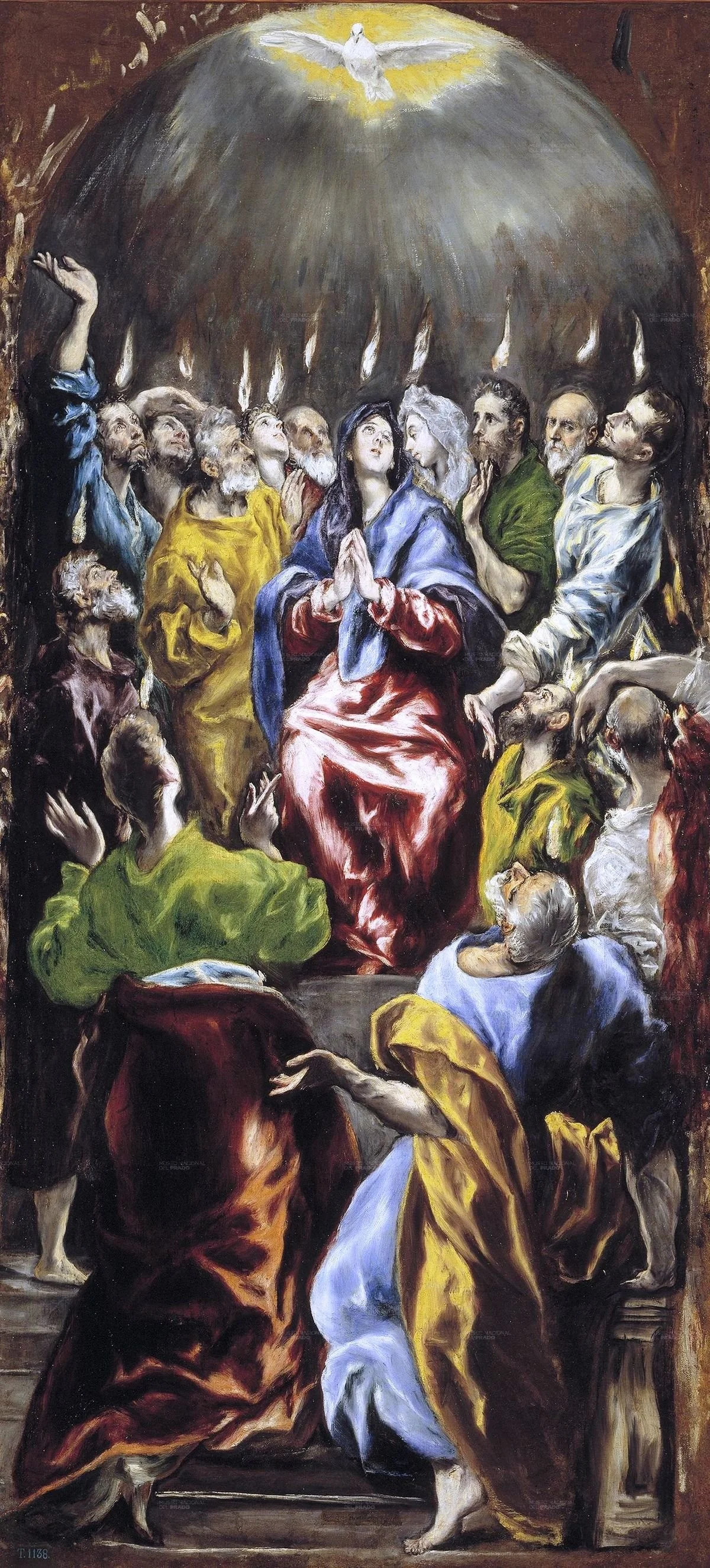
Pentecost, El Greco, c. 1596-1600, The Prado, Madrid, public domain, click on image to link to source.
The second chapter of Revelation begins with a message in symbolic language from Jesus, who holds the seven “stars” or angels in his right hand, and walks among the seven “lampstands” or congregations. “I have this against you,” he says to the church at Ephesus, “that you have abandoned the love you had at first.”
I saw something circulating on the internet that I associate with these words, and generated a similar image that I asked Beth to put in your bulletin. It shows four generations of a family sitting together on a couch. Above each person's head is a thought balloon.
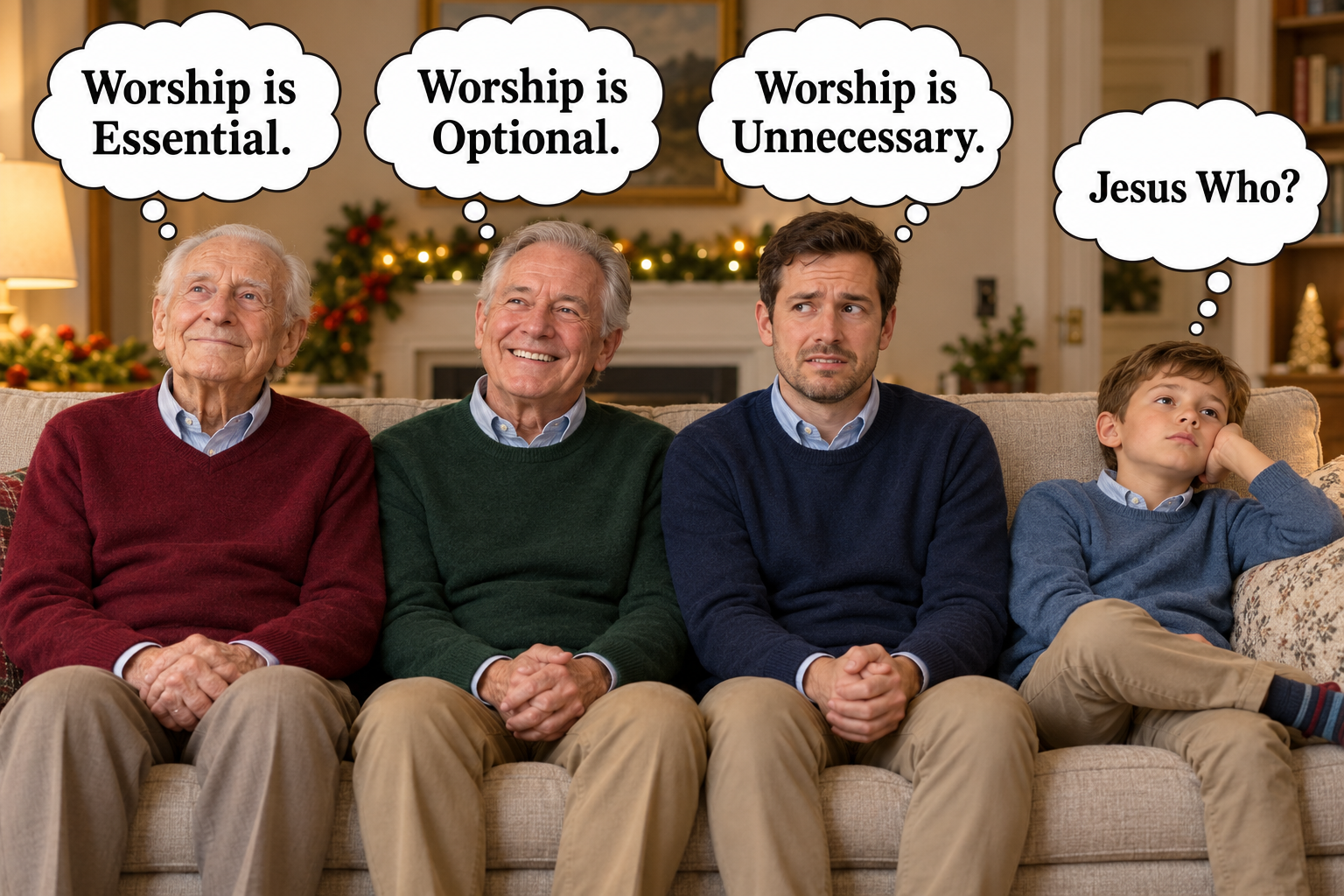
The great-grandfather says, “Worship is essential.”
The grandfather says, “Worship is optional.”
The father says, “Worship is unnecessary.”
And the son says, “Jesus who?”
Like most things on the internet, it is much too simple. The decline of Christian faith and practice across generations has many causes. And yet the little cartoon gets at something real. What one generation regards as essential, another can regard as optional. What becomes optional can eventually become unnecessary. And what is no longer practiced may eventually cease to be remembered at all.
“One generation stopped practicing what it had inherited; eventually another generation stopped inheriting it.”
Perhaps that is one way of hearing the words to Ephesus: “You have abandoned the love you had at first.”
I think about my own childhood and young adulthood. The church was what sociologists today sometimes call a “third place.” There was home. There was school. And there was church.
Church wasn't simply someplace we went for an hour when nothing else was happening. It was one of the places around which life was organized. There were worship services and Sunday school classes, youth activities and choirs, fellowship dinners and service projects. There were friendships there. There were adults other than our parents who knew us, encouraged us, corrected us, and watched us grow up.
And “regular attendance” meant something different from what it often means today. For many families, regular participation might have meant forty or more Sundays in a year.
That world has changed.
Today someone may quite sincerely consider themselves a regular participant in the life of a congregation while attending considerably less often. Weekends have become crowded with activities that earlier generations generally scheduled at other times. Families are geographically scattered. Work schedules have changed. Travel is easier. Children's activities multiply. And the cultural expectation that Sunday morning belongs to church has largely disappeared.
I don't say that to scold anyone. Nor do I imagine some golden age when everybody went to church for all the right reasons. They didn't.
But something has changed. Perhaps Revelation invites us to ask not simply, “Why don't people come as often as they once did?” but a deeper question: What happens to a church when the practices that make us a church become less and less central to our lives?
The church at Ephesus is interesting in this regard because, by many measures, it seems to be doing quite well. “I know your works,” Christ says. “Your toil and your patient endurance.” These are faithful people. They have endured hardship. They have resisted false teaching. They have kept on keeping on. And yet: “You have abandoned the love you had at first.” “Remember then from what you have fallen; repent, and do the works you did at first.”
And finally comes the refrain: “Let anyone who has an ear listen to what the Spirit is saying to the churches.”Listen to what the Spirit is saying to the churches.
Our other Scripture lesson takes us back to the beginning of the Church. At Pentecost, the Spirit descends upon the disciples. Peter proclaims the gospel. People respond. And then Luke tells us what this Spirit-created community begins to look like. “They devoted themselves to the apostles' teaching and fellowship, to the breaking of bread and the prayers.” They worship. They learn. They eat together. They pray together. They care for people in need. They share their possessions. They gather in the temple and around tables in their homes.
More than forty years ago, the theologian Gabriel Fackre described four “marks” of the church that become visible in the outpouring of the Spirit at Pentecost.
Kerygma — proclamation. The story is told. The good news of Jesus Christ is announced.
Leitourgia — worship. God's people gather in praise and prayer, around Word and Sacrament.
Diakonia — service. Faith turns outward in love toward neighbor and especially toward those in need.
Koinonia — fellowship, communion, shared life. People who otherwise might have little in common discover that in Christ they belong to one another.
Proclamation. Worship. Service. Fellowship. The four marks really were the way I defined church during the decade of my 20s.
And Fackre's point is important: these aren't simply four programs that a successful congregation ought to have.
They are manifestations of the Holy Spirit.
The Spirit gathers people. The Spirit opens hearts. The Spirit inspires proclamation. The Spirit creates fellowship. The Spirit sends people into service. The Spirit is at work doing these things in ways that actually define the essence of a church in the New Testament tradition.
Which raises an uncomfortable question in an age of church decline.
If these things become less and less evident among us, at what point do we have to ask: To what extent are we still being the church? What is the church today, and where is all this leading us?
John Updike explored something like this in his novel In the Beauty of the Lilies. The story begins with a Presbyterian minister, Clarence Wilmot, who loses his Christian faith. Updike then follows his family through succeeding generations.
What begins in one generation as a crisis of faith becomes something different in the next. Faith becomes more distant. The Christian inheritance becomes thinner. And eventually the religious longings that remain seek other places to attach themselves.
Even the title is significant. In the Beauty of the Lilies comes from an old hymn, “The Battle Hymn of the Republic.”
One generation hears the hymn behind the words.
A later generation may hear the words with no idea what they mean. Which republic? Where’s the battle? What is a “hymn” other than the opposite of “her”?
Updike tells in hundreds of pages what that little internet cartoon tries to say in four thought balloons, as we get to the final generation that responds to questions of faith with its own question: “Jesus who?”
And that brings us to a question appropriate to Reformation Sunday.
What do we do?
One possible response is nostalgia. We can remember when the Sunday school rooms were full, when youth groups were larger, when Sunday mornings were protected from competition, when church occupied a more prominent place in American culture. But nostalgia can’t reform the church.
Another response is anxiety. We can study statistics, count attendance, project budgets, and wonder whether congregations and denominations will survive another generation. Those questions aren't unimportant, especially for the elders managing congregations, and leaders trimming the budgets and staff rosters at headquarters for a future than can’t quite envision. But anxiety can’t reform the church either.
Reformation Sunday reminds us that the church does not finally belong to us. The church belongs to Jesus Christ. And Pentecost reminds us that the church was not created by human ingenuity in the first place. It was called into being by the Holy Spirit. Perhaps, then, the most important question before us isn't, “How do we make sure the institution survives?” Perhaps it is: How do we remain open to the Spirit? How do we listen again? How do we proclaim the good news of Jesus Christ in words people can actually hear? How do we worship God with hearts as well as lips? How do we serve our neighbors in ways that embody Christ's love? How do we cultivate a fellowship deep enough that people discover here not simply an organization they attend, but a people to whom they belong?
Kerygma. Leitourgia. Diakonia. Koinonia.
Proclamation. Worship. Service. Fellowship.
We cannot guarantee what the institutional church will look like fifty years from now, or that the Presbyterian Church will even exist as anything other than history. But neither could Luther. Calvin and Knox couldn’t do it. Neither could the apostles gathered in Jerusalem at Pentecost. But we can listen. “Let anyone who has an ear listen to what the Spirit is saying to the churches.”
The same Spirit who gathered frightened disciples behind closed doors still gathers God's people. The same Spirit who gave Peter words to proclaim still gives the church a story to tell. The same Spirit who drew strangers into fellowship still creates community. The same Spirit who moved believers to care for those in need still sends us into service.
Perhaps our calling in a time of decline is not first to preserve the church. Perhaps it is to be the church—and to trust the Spirit with what comes next. As I approach the conclusion of my ministry journey, I’m learning that the future of the church does not finally rest upon our ability to reproduce the church we remember. It rests with the God who has always been able to call, gather, enlighten, and set apart a people in a special community.
Remember the love we had at first.
Do again the works that flow from that love.
And with ears and hearts open, we listen for what the Spirit is saying to the churches.
In the name of the Father, and of the Son, and of the Holy Spirit. Amen.