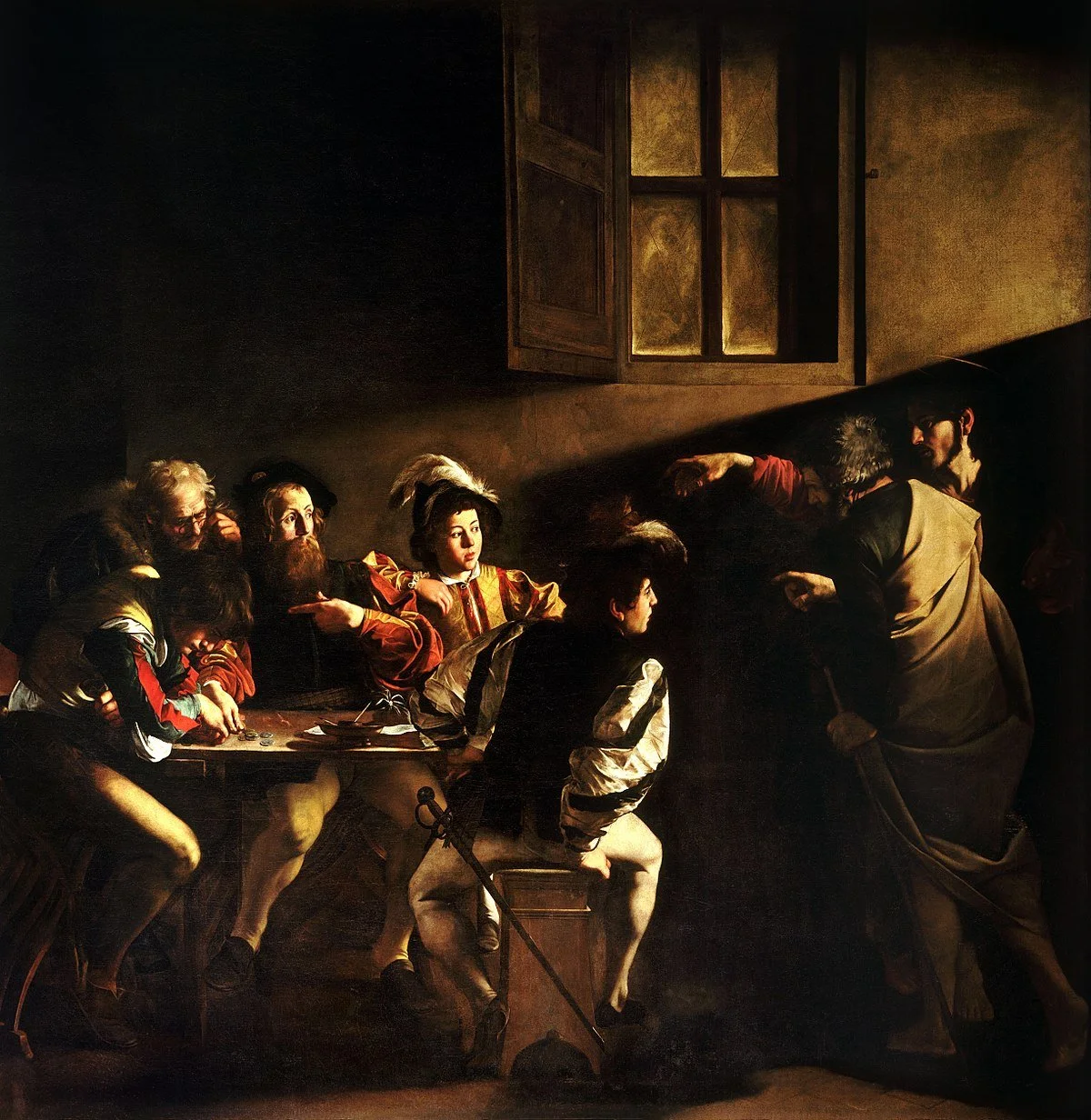
Calling of St. Matthew, oil on canvas, c. 1600, by Caravaggio, San Luigi dei Francesi, Rome, Italy, public domain, click on image to link to source.
Genesis 12:1-9; Matthew 9:9-13
In this gospel text, we hear Jesus’ observation “Those who are well have no need of a physician, but those who are sick.” On the surface, Jesus states an obvious truth. In context, and at a deeper level, Jesus is making an observation about human nature. If a person doesn’t know he or she is morally sick, then they will never seek a remedy. Conversely, those who know they are unhealthy, and troubled by the fact, are the ones most eager for and open to a cure when it appears.
A simpler, folksier way to say this: You have to admit you’re sick before there is any possibility of finding a cure to what ails you.
In this vein, I’ve filed away a story from one of my favorite preachers John Buchanan, who once pastored the Fourth Presbyterian Church in Chicago. He shared a story told by his father, who worked for the railroad. Every day at lunchtime, another railroader opened his lunch pail, took out the contents, and complained, “Same old bologna sandwiches! I’m so tired of bologna sandwiches! I hate bologna! I’d give anything for a different sandwich some day!” Buchanan’s father would ask, “Well, why don’t you ask your wife to make you different sandwiches?” His friend answered, “My wife doesn’t make these sandwiches. I do.”[1]
Buchanan’s story, too, speaks to a kind of psychological inertia; in some cases, a human body at rest tends to stay at rest. You encounter a person stuck in a chronically disappointing or depressing situation. You suggest a new and previously unconsidered solution. Surprisingly, your suggestion seems only to reinforce nostalgia for what is familiar and secure, no matter how unhealthy.
Your encounter highlights a spiritual dilemma we all face at one time or another: in order to take hold of Christ’s hand, and follow him into God’s promised future, you have to let go of that which anchors you to an undesirable present.
In today’s first scripture reading, we heard the story of Abraham’s (Abram’s) call. He responded to God’s call to travel to an unknown land and take up a completely new life. Think how different and unsupported such a journey would have felt. No GPS and no paper maps. No truck stops and drive-through fast food. How difficult it must have been to let go of all that was familiar and sustained daily life.
Though separated by centuries, Matthew (like Abraham) faces the same spiritual challenge: letting go of a familiar world in order to follow God into unfamiliar territory.
One of the most puzzling aspects of Matthew’s journey is the suddenness with which he embarks on his new life of discipleship. He has been engaged in work as a tax collector, probably for a long time. We may reasonably assume that he has commitments to his employer, friends, and family. We want to know what was going on in Matthew’s head, how long he had been contemplating a drastic change in his life’s direction, and whether he had been observing Jesus at a distance for some time before this particular encounter.
Tom Long says: “Because we live in a psychologically sophisticated age, we want to know why he responded this way, and we are tempted to read his mind and his motivations.” [2] The gospel record doesn’t satisfy our curiosity. It simply says that Jesus commanded Matthew to follow, and that Matthew followed. But we might take a hint from the event that follows. When Jesus said, “Those who are well have no need of a physician, but those who are sick,” perhaps he was thinking of the recent past, the look in Matthew’s eyes when Jesus issued the invitation. Perhaps Matthew had grown weary of the compromises, isolation, and spiritual emptiness that accompanied his work. Whatever the particulars, Jesus saw someone who knew he needed a different life. And when the call came, Matthew was ready to let go of whatever was anchoring him to an undesirable present, to grab hold of Christ’s hand, and follow him into God’s promised future.
Michael Lindvall shares a story from the life of Henri Nouwen, the famous Dutch priest and author. Nouwen told about his association with “The Flying Rodleighs,” a troop of trapeze artists who performed with a German circus. “When the circus came to Freiburg,” he writes, “my friends … invited me and my father to see the show. I will never forget how enraptured I became when I first saw the Rodleighs move through the air, flying and catching, as elegant dancers. The next day, I returned to the circus to see them again and introduced myself to them as one of their great fans. They invited me to attend their practice sessions, gave me free tickets, asked me to dinner, and suggested that I travel with them for a week in the near future.”
“One day, I was sitting with Rodleigh, the leader of the troop, in his caravan, talking about flying. He said, ‘As a flyer, I must have complete trust in my catcher. The public might think that I am the great star of the trapeze, but the real star is Joe, my catcher. He has to be there for me with split-second precision and grab me out of the air as I come to him in the long jump.’ ‘How does it work?’ Nouwen asked. ‘The secret,’ said Rodleigh, ‘is that the flyer does nothing and the catcher does everything. When I fly to Joe, I have simply to stretch out my arms and hands and wait for him to catch me and pull me to safety …’”
“’You do nothing!’ said Nouwen, surprised. ‘Nothing,’ Rodleigh repeated. ‘The worst thing a flyer can do is to try to catch the catcher. I am not supposed to catch Joe; it’s Joe’s task to catch me. If I grabbed Joe’s wrists, I might break them, or he might break mine, and that would be the end for both of us. A flyer must fly, and a catcher must catch, and the flyer must trust, with outstretched arms that his catcher will be there for him.’”[3]
The good news is that Christian faith is not ultimately about the strength of our grip on God. It is about trusting God's grip on us.
Perhaps you come to worship this morning feeling like you’re walking a tightrope, engaged in your own dramatic high-wire act. You hear the voice of Christ calling you to forgive an old hurt, release a long-carried resentment, or embrace a healthier set of relationships. But you’re afraid that you will fall.
In order to take hold of Christ’s hand, and follow him into God’s promised future, you have to let go of whatever keeps you chained to yesterday. You can’t hang onto a trapeze swing forever. Sooner or later, you have to let go, and let God catch you.
In the name of the Father, and of the Son, and of the Holy Spirit. AMEN.
NOTES
[1] John Buchanan, “How Far Are We Supposed to Follow?”, a sermon delivered to the Fourth Presbyterian Church, Chicago, 9 June 2002.
[2] Thomas G. Long, Matthew, Westminster Bible Companion, Louisville: Westminster John Knox Press, 1997, p. 103.
[3] Henri Nouwen, as quoted by Michael L. Lindvall, “Just Do It,” a sermon delivered to the Brick Presbyterian Church, New York, New York, 5 June 2005.
READ MORE, https://www.fpcedw.org/pastors-blog